the veterinarian (Nutmeg's father)
The Wind-Up Bird ChronicleThe veterinarian is Nutmeg Akasaka’s father and Cinnamon Akasaka’s grandfather, a respected professional whose life is shaped by an enduring blue mark on his right cheek and by his conviction that personal choices are subject to an outside force. In Hsin-ching in August 1945, he witnesses the killing of zoo animals as Soviet troops advance; he later tells the story to Cinnamon, and their repeated retellings grow into an interlocking family mythology. His character joins practical competence to fatalistic resignation, making him a human link between wartime history, inherited memory, and the novel’s uncanny present.
Identity and Background
The veterinarian is introduced through several generations of family connection: he is the father of Nutmeg Akasaka and grandfather of Cinnamon Akasaka. His place in the family’s history is also carried by the blue mark on his right cheek, a visible bodily distinction he bore from childhood. The mark made him feel singled out and exposed to other people’s attention; as he grew older, he gradually accepted it, and that acceptance became entangled with his understanding of fate.
He is not presented as professionally passive. He is an exceptionally capable veterinarian and a tireless educator, with a record of strong academic performance and leadership. Colleagues recognize his skill, and younger workers look up to him. Yet competence does not give him a sense of complete independence: even when he acts decisively, he doubts that his decisions originate solely in his own will.
The Zoo in Hsin-ching
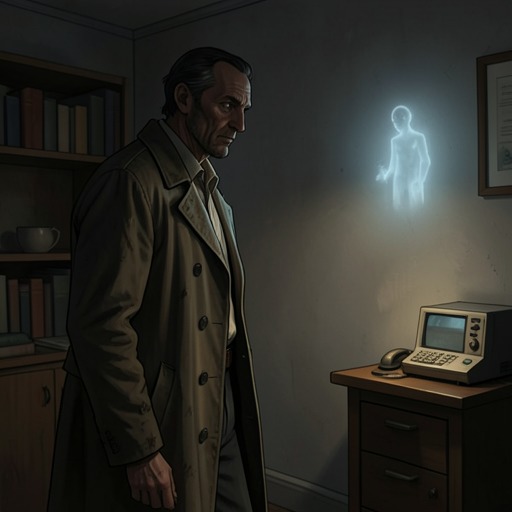
In August 1945, while living and working in Hsin-ching, the veterinarian wakes to a zoo transformed by the previous day’s executions. Tigers, leopards, wolves, and bears have been killed by soldiers. The aftermath confronts him in the ordinary setting of his morning routine: he washes, eats breakfast, and listens to the animals, but the missing voices make the day unlike the one before. He understands that the killings were real, not a nightmare, as Soviet troops press closer to the city.
The elephants have survived because the young lieutenant in charge of the platoon removed them from the execution list. Their survival gives the veterinarian some relief amid the loss. The episode places his professional knowledge and concern for animals against the military order that has turned the zoo into a site of deliberate killing. He continues to care for the animals under severe wartime conditions, noting that food is scarce but still more plentiful than in zoos in the Japanese homeland.
His family is absent from the official residence. His wife and daughter have left for Japan by way of Pusan, where they are expected to stay with a railway-worker cousin until they can board a transport ship. He misses their presence and recognizes that the house no longer feels like the home he loved. At the same time, their departure leaves him alone with an unsettling sense of fate’s power, joining the intimate separation of family life to the larger upheaval of war.
Fate and the Cheek Mark
The veterinarian understands fate as a force that operates beyond conscious intention. From childhood, the blue mark on his cheek seemed to him like evidence that an external power had singled him out. He hated it when other children mocked him or strangers stared; as a child, he wished he could remove the marked part of his body. With age, he stopped resisting the mark and accepted its permanence, a shift that helped shape his resignation toward events he could not control.
He describes this force not as a constant crisis but as a low, persistent presence that occasionally intensifies. When it does, he feels compelled to abandon resistance and yield to its course, convinced that no action or thought can alter what fate demands. This belief coexists with considerable agency in practical matters: he is capable, decisive, and persistent in his work. The tension is central to his characterization. He does make decisions, but he cannot experience them as wholly his own; even after acting freely, he suspects that the decision had already been made for him by an external power.
The Story He Gives Cinnamon
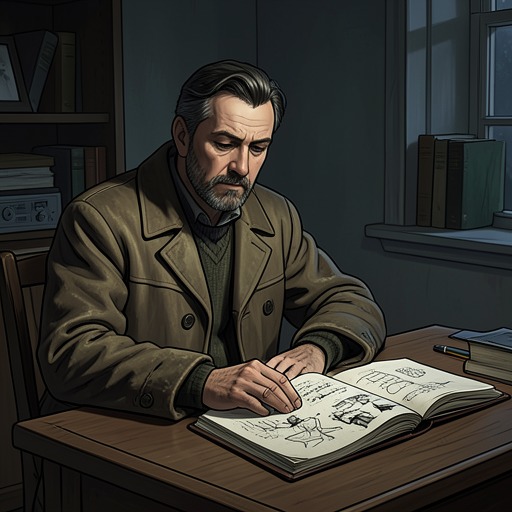
The veterinarian keeps the wartime story to himself for a long time. After Cinnamon is born, he decides that his grandson is the one person to whom he can tell what he witnessed from the deck of a transport ship in August 1945: the killing of the animals in his zoo while an American submarine trained its cannon on the ship. He repeats the story to Cinnamon even before the child can understand words. Telling it makes the remembered scenes vivid to him, as though the act of narration releases what had been contained within memory.
As Cinnamon learns language, he asks to hear the story again and again. The veterinarian recounts it hundreds of times, but the telling does not remain identical. Cinnamon asks about smaller stories branching from the central account, and his grandfather follows these paths into further details. Together they elaborate the animals, soldiers, and circumstances, gradually building what the veterinarian calls an interlocking system of myths. A single concealed memory becomes an expanding shared world, shaped by repetition and by the questions of the child who receives it.
That shared practice ends on the morning Cinnamon stops talking. Nutmeg later interprets the silence as the stories having swallowed his words: something from the stones took his tongue, she says, and years afterward the same force killed her husband. Her account presents the family history through a different, supernatural explanation, while the veterinarian’s own role in creating and retelling the stories offers a concrete connection between silence, memory, and the family’s mythology. The story he entrusted to Cinnamon thus persists, but the act of passing it on is bound to the loss of Cinnamon’s speech.
Connections and Narrative Significance
The veterinarian belongs to a chain of relationships that connects domestic life to the wartime past. The blue cheek mark links him to Cinnamon and to people who come to Nutmeg for treatment; the mark becomes a point of recognition across otherwise separate lives. His story also joins the Hsin-ching zoo to the experiences of Lieutenant Mamiya and Mr. Honda, whose histories involve the Manchurian-Mongolian border and the same wider region. Toru Okada sees these connections as part of a circle centered on prewar Manchuria, continental East Asia, and the 1939 conflict at Nomonhan, even though the people caught in that chain were born long afterward.
The veterinarian’s significance rests in the passage between generations and forms of knowledge. He is at once a competent professional, a witness to wartime violence, a father separated from his family, and a narrator who turns a withheld memory into a shared mythology. His confidence in fate does not erase the concrete acts through which history reaches later generations: the mark remains on the body, the story is told and retold, and the grandson’s silence changes what that inherited story can become.